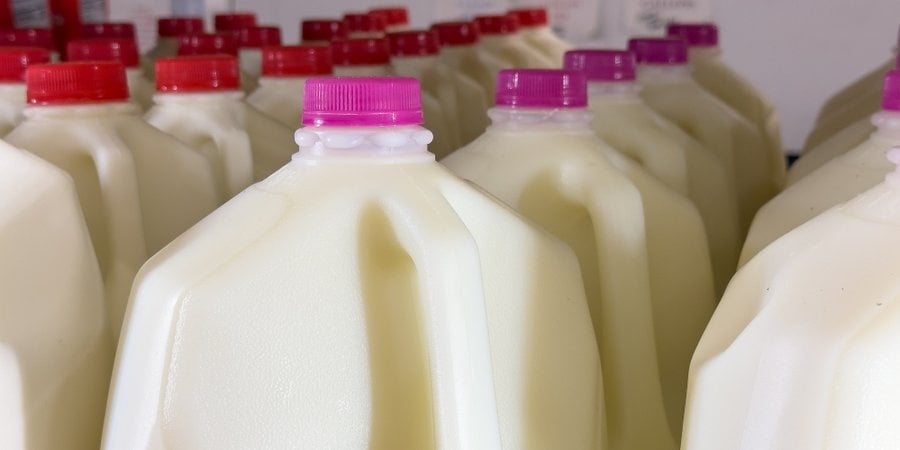



Organic dairy farmers are suing the federal government, arguing that a decades-old milk pricing system siphons tens of millions of dollars from organic dairy farmers each year to benefit industrial milk producers. The outcome of the lawsuits could curb how much money flows from organic to industrial dairies via the USDA, which would be a boost for the organic milk industry.
Organic dairy farmers are suing the federal government, arguing that a decades-old milk pricing system siphons tens of millions of dollars from organic dairy farmers each year to benefit the much larger non-organic dairy farming industry, often referred to as “conventional dairy.”
The organic milk market made up just 7% of all milk products sold in 2025.
The lawsuits challenge the U.S. Department of Agriculture’s (USDA) federal milk marketing orders (FMMOs), a regulatory system designed to stabilize dairy prices by pooling and redistributing revenue across the industry.
Plaintiffs argue that the system does not account for organic dairies’ higher operating costs for feed and labor, among other things, and a separate market, forcing processors to pay into pricing pools that primarily benefit conventional dairy.
The outcome could curb how much money flows from organic to industrial dairies via the USDA, which would be a boost for the organic milk industry.
What’s required of organic dairy farms
Both conventional and organic dairies are subject to federal safety and quality standards, but their on-farm management practices differ based on the requirements of the federal regulations that govern certified organic farms.
Large conventional dairies can confine up to hundreds of thousands of animals in tightly packed conditions. While there are some large organic dairy operations, these operations house around twenty thousand animals at a time.
Certified organic dairies are required to provide regular access to pasture and only confine cattle temporarily for purposes such as healthcare, breeding and shipping.
Growth hormones are prohibited; feed must be 100% organic and any animal treated with antibiotics is removed from the herd and often sold to a conventional market.
Organic producers, processors and brands operate within a separate supply chain from the conventional dairy industry. While organic dairies are exempt from paying into the federal checkoff program, which is designed to promote and increase demand for dairy products, the FMMO regulatory system treats organic milk as interchangeable with conventional milk.
“We’re paying into a system that doesn’t have anything to do with the reality of the organic markets. That’s the part that’s frustrating,” says Blake Alexandre, fourth-generation dairy farmer and co-founder of the organic Alexandre Family Farm.
“We’re paying into it and not getting any benefit out, because organic is such a unique and separate market from conventional commodity pricing.”
“Organic sales and revenues generated in the marketplace should stay in the organic dairy ecosystem,” argues Adam Warthesen, vice president of government and industry affairs at the food company Organic Valley. “What the orders do is they make sure that isn’t the case.”
The legal actions — announced April 28 by the Coalition for Organic Dairy Exemption, a group comprised of Organic Valley|CROPP Cooperative, Aurora Organic Dairy and Horizon Organic Dairy — include three federal court filings and a class action claim asking courts to exempt organic dairy from the FMMO regulatory system.
They also seek partial compensation to farmers “for six years of wrongfully collected payments into the system.”
Under FMMOs — a program created by the USDA in the 1930s before organic dairy existed — all milk processors are required to pay into a pool that is redistributed to ensure farmers receive a minimum price for their milk.
Supporters say pooling helps stabilize prices across the dairy industry and ensures a consistent milk supply.
Opponents say that, because the system is based on conventional milk, organic producers — who consistently sell at higher prices — pay into the system but receive almost none of the returns, effectively subsidizing conventional dairy.
“At a really high level, this program is about shared risk, shared cost and then shared benefit,” says Tom Chapman, co-CEO of the Organic Trade Association, which represents more than 10,000 organic U.S. businesses and farmers.
“But for organic, we get all the shared costs, we get all the shared risk, but we don’t get the shared benefit.”
The USDA has not yet publicly responded to the lawsuit and did not respond to a request for comment.
The organic dairy industry’s fight against FMMOs
The organic dairies’ push for exemption from FMMOs is not new. In 2015, the Organic Trade Association filed a proposal with the USDA to amend the system to recognize organic dairy as a distinct industry.
Facing strong opposition from conventional dairy groups, the group ultimately withdrew the proposal.
In 2023, organic processors, including Organic Valley|CROPP Cooperative, Aurora Organic Dairy and Horizon Organic, submitted proposals to a federal hearing on broader updates to the FMMOs. The USDA refused to hear them.
“They didn’t consider the testimony around organic and the evidence around organic,” argues Sally Keefe, a consultant for the Coalition for Organic Dairy Exemption.
Following the hearing, in 2025, the USDA adopted pricing formula changes that organic producers say increased the cost burden on their sector.
Organic Valley, a farmer-owned organic cooperative that reports producing more than 30% of organic milk sold in the U.S., saw the cost of FMMOs rise by up to 60% after the 2025 rules changes.
“It’s horrific,” says Warthesen, adding that the money would otherwise be invested back into the co-op and its independent family farmer membership.
Chapman says FMMOs are an incredibly complex system, which is why the USDA hasn’t taken action. He blames the lack of change on “the inertia of the federal government system, and its inability to reform some of its antiquated regulations.”
What the lawsuit could change
The vast majority of consumers do not know that the FMMOs exist, and it is unclear whether changes would translate to a cost difference in stores. However, if successful, the federal lawsuits could benefit the entire organic dairy supply chain by keeping resources within the organic sector, Keefe says.
This could mean an increase in the net price organic farmers receive for their milk, which could help grow organic’s share in the dairy market. It could give farmers more capital to invest in innovation or tackle logistical challenges like hauling.
“There’s a lot that goes into getting milk all the way from the farm to somebody’s refrigerator,” Keefe says.