



U.S. Supreme Court Liability Shield Review for Bayer-Monsanto’s Glyphosate is Up Next…
For the past three years, grassroots activists, leading farm advocates, and environmental groups have been working to shut down a growing number of pesticide liability shield bills that Bayer-Monsanto and their Big Ag allies have been trying to pass in Congress and state capitals across the country.
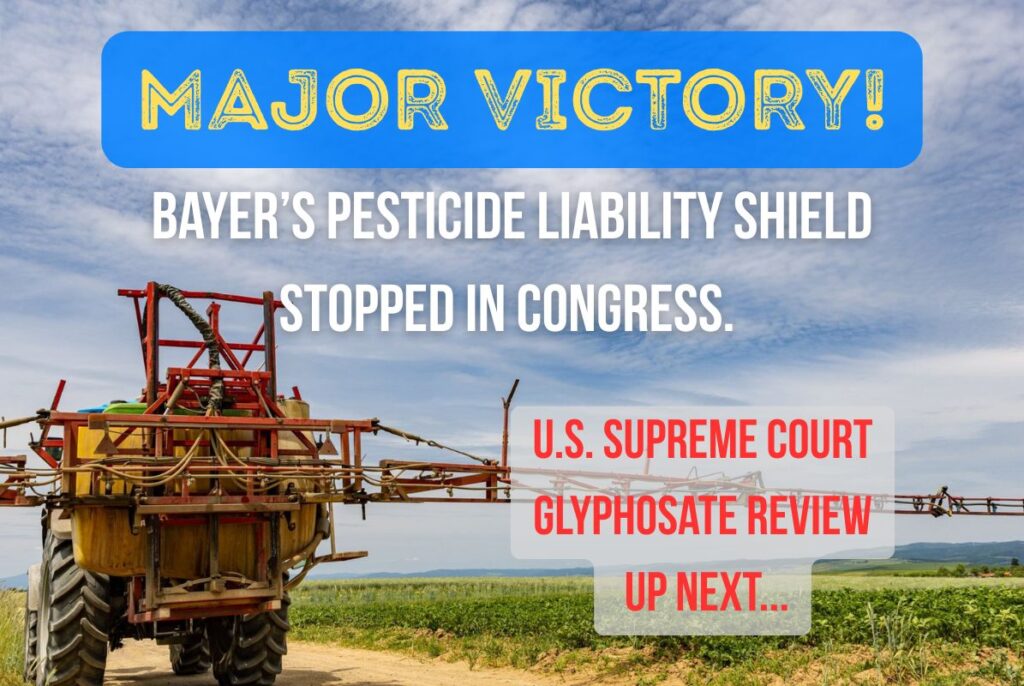
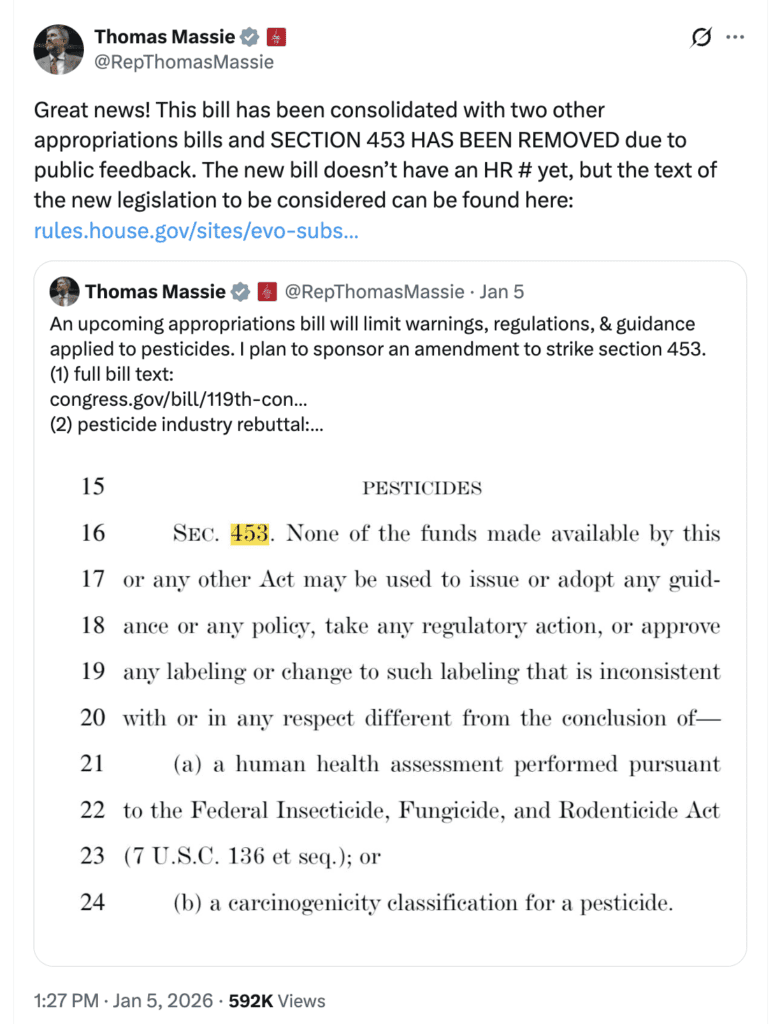
This week, on Monday, January 7th, the halls of Congress finally heard the resounding pressure that has been building since this summer, when the pesticide liability shield provision, Section 453, which was quietly snuck into a must-pass FY 2026 Interior, Environment Appropriations Bill or H.R. 4754, was removed at the last minute due to intense grassroots pressure.
The removal of Section 453 was widely hailed by advocates for soil health and regenerative agriculture, including Congressman Thomas Massey (R-KY), a longtime homesteader and advocate for limited government.
Bayer-Monsanto’s Growing Roundup Cancer Lawsuit Problem
Bayer stepped into the financial hot seat in 2018 when it acquired Monsanto in a merger between the German pharmaceutical giant and the St. Louis-based pesticide and biotech seed giant, long known to bully U.S. farmers, politicians, and activists. Since that purchase, Bayer has faced one of the largest product liability legal battles in U.S. history over Roundup, its glyphosate-based weedkiller, and its known link to cancer. Many family farmers and long-time farm reformers were surprised by Bayer’s 2018 purchase of Monsanto, but have not been surprised by the cancer lawsuit outcomes, given Monsanto’s extensive history of scientific corruption and their decades-long manipulation of the science behind glyphosate’s alleged safety.
As of October 2025, Bayer-Monsanto has faced nearly:
197,000 lawsuits linking Roundup/glyphosate to cancer
132,000 cases are settled or ineligible
With 65,000 unresolved cases
Bayer has already paid out an estimated $11 billion in settlements and jury awards, but continues to face litigation in both state and federal courts.
Since October 2023, there have been 8 successful Roundup verdicts against Bayer totaling more than $6 billion in settlements alone, prompting the German-based pharmaceutical company to pursue a desperate legal strategy that further alienates them from farmers and citizens around the world.
MAHA Activists Put White House and Republicans on Notice
This past summer, I was asked, along with several others, to help write a letter to President Trump on behalf of the growing MAHA coalition, and I made sure we spelled out the political implications of allowing any pesticide liability shield to pass for members of Congress. We hoped to ground our arguments in constitutional principles while also incorporating the latest science and polling data to make sure they understood the importance of the issue to MAHA and the American public.
From the letter: President Trump — Say No to Pesticide Liability Shields
“If Republicans do not lead, they risk losing both moral ground and political support.
A 2024 poll by Accountable Iowa of Iowa Republicans found that efforts to pass cancer lawsuit liability bills, which were defeated in the Iowa state legislature this year, could significantly cost Republicans in state and federal elections in 2026.
87% of registered Republican respondents oppose giving chemical companies like Bayer-Monsanto immunity from lawsuits.
94% of surveyed Republican voters agreed that it is very concerning that the EPA relies on industry-funded data to carry out safety studies.”
After years of political indifference from Republican elected officials, these poll numbers showing extremely high levels of Iowa Republican voters who oppose immunity shields for Bayer-Monsanto and distrust of the EPA’s support for industry-funded science seem to have finally gotten their attention.
Failure to heed such high polling numbers could well spell doom for Republicans’ efforts to maintain control of the House of Representatives. Despite Trump and Republicans’ resounding victory in the 2024 election against Vice President Kamala Harris and their retaking of the House and Senate, Republicans’ risk of losing the House in the Midterms is already starting to cause heartburn in the White House. Just this week, President Trump himself discussed a possible 3rd Impeachment if Republicans lose the House.
What Section 453 and Pesticide Liability Shields Would Do
If Section 453 had remained in the bill, it would have blocked federal funding for EPA scientists to update pesticide warning labels and prevented EPA officials from including updated guidance on more than 57,000 synthetic pesticide or chemical labels if they differed from previous EPA health assessments.
While seemingly innocuous, the now-removed language stated:
“SEC. 453. None of the funds made available by this or any other Act may be used to issue or adopt any guidance or any policy, take any regulatory action, or approve any labeling or change to such labeling that is inconsistent with or in any respect different from the conclusion of
(a) a human health assessment performed pursuant to the Federal Insecticide, Fungicide, and Rodenticide Act; or
(b) a carcinogenicity classification for a pesticide.”
The provision was intentionally and deceptively written so that, even when new science emerged showing increased risks, EPA scientists would not be allowed to update or expedite a review of the chemical’s warning labels.
Protecting Pesticide Profits over Public Health and Informed Consent
Typically, common pesticides or household chemicals are only reviewed every 15 years and Section 453 would have allowed a massive loophole that protected pesticide manufacturers like Bayer-Monsanto, Syngenta, and ChemChina, which are foreign owned and now manufacture the most widely used pesticides in the U.S. such as glyphosate, atrazine, and paraquat, which have been credibly linked to infertility, cancer, endocrine disruption, and neurological disorders like Parkinson’s disease.
Outdated labels mean there are no real warnings for family farmers, pesticide applicators, or American consumers who either use these products or are exposed to them through no fault of their own.
This also means Congress would have denied “informed consent” to the American public, simply to protect the profits of foreign pesticide manufacturers and shield them from future “failure-to-warn” lawsuits. Providing a liability shield for pesticide companies has been compared to the much-reviled law Congress passed for vaccine manufacturers under the National Childhood Vaccine Injury Act of 1986 or the 1986 Act.
Why This Matters — Landmark Glyphosate Paper Retracted
Monsanto’s Decades of Fraudulent, Ghostwritten “Studies” Finally Catches Up with Them
For the past 50-plus years, the U.S. Environmental Protection Agency (EPA) has relied on industry-funded research to determine the agency’s “safety assessments” to approve whether a new pesticide or household chemical should be allowed on the market.
Many of these safety assessments are decades old and relied on corporations like Monsanto, DuPont, Syngenta, and Dow Chemical to report data from their own “scientific studies” for the EPA’s approval. Shockingly, the EPA does not conduct any of its own independent peer-reviewed studies for approvals, a fact not widely known by most U.S. elected officials and the general public, who naively rely on the agency’s scientists to vouch for a chemical’s safety.
The real question is, how long does it take for regulatory and scientific fraud to be discovered?
In the case of the most widely used pesticide on the market, Roundup and its glyphosate-based weedkillers, this scientific fraud has taken decades to unravel.
Major Retraction on Monsanto’s Roundup Rocks Pesticide Regulators
Last month, in the first week of December, the retraction of a major scientific peer-review study that formed “a cornerstone in the assessment of glyphosate’s safety”, was finally issued a full 8 years after the fraud by its authors was initailly discovered.
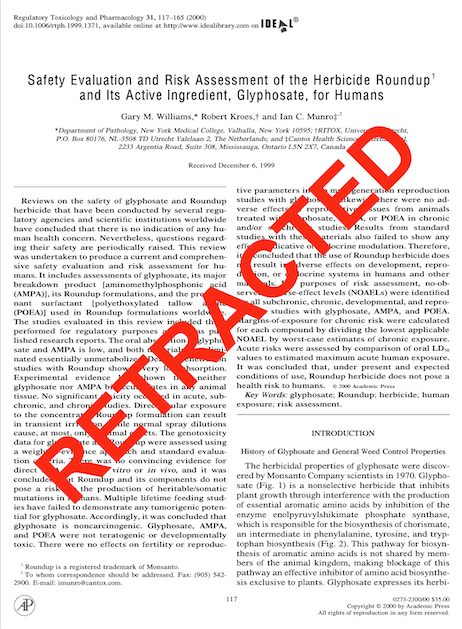
The now infamous paper, allegedly authored by Williams, Kroes, and Munro, was published in 2000 and concludes, “under present and expected conditions of use, Roundup herbicide does not pose a health risk to humans”.
The secretive involvement of Monsanto scientists was only unearthed when lawyers, including now HHS Secretary RFK, Jr., suing Monsanto for glyphosate’s link to cancer in a class action lawsuit found emails during the discovery process that unraveled the carefully protected plot to deceive the scientific community were made public.
In the retraction issued in Regulatory Toxicology and Pharmacologyjournal by Editor-in-Chief, Prof. Martin van den Berg, Ph.D.:
“Concerns were raised regarding the authorship of this paper, validity of the research findings in the context of misrepresentation of the contributions by the authors and the study sponsor and potential conflicts of interest of the authors.”
For a corporation like Monsanto, long known to ghostwrite studiesand pay scientists under the table for research, editorials, and to put their names on studies they barely reviewed, it doesn’t get any worse than this.
Retracted Study’s “Historical Context and Influence” Includes 779 Citations and 66 Policy Citations
For 25 years, this allegedly independent peer-reviewed study titled: “Safety Evaluation and Risk Assessment of the Herbicide Roundup and Its Active Ingredient, Glyphosate, for Humans”, was used by Monsanto and regulatory bodies around the world to pretend that Roundup, and its main active chemical ingredient glyphosate, were perfectly safe.
According to the retraction notice, the charges of scientific misconduct are serious and have wide-ranging impacts.
In his recent retraction notice, Editor-in-Chief, Prof. Martin van den Berg, Ph.D states the charges of scientific fraud clearly below:
1. “The paper had a significant impact on regulatory decision-making regarding glyphosate and Roundup for decades.”
2. “This article has been widely regarded as a hallmark paper in the discourse surrounding the carcinogenicity of glyphosate and Roundup. However, the lack of clarity regarding which parts of the article were authored by Monsanto employees creates uncertainty about the integrity of the conclusions drawn.”
3. “Specifically, the article asserts the absence of carcinogenicity associated with glyphosate or its technical formulation, Roundup. It is unclear how much of the conclusions of the authors were influenced by external contributions of Monsanto without proper acknowledgments.”
4. “This lack of transparency raises serious ethical concernsregarding the independence and accountability of the authors of this article and the academic integrity of the carcinogenicity studies presented.”
5. “The potential biases introduced by undisclosed contributions from Monsanto employees and the exclusion of other existing long-term carcinogenicity studies may have skewed the interpretation of the data. The authors’ critical analysis of both unpublished and published studies must therefore be viewed with caution.”
6. “Further correspondence with Monsanto disclosed during litigation indicates that the authors may have received financial compensation from Monsanto for their work on this article, which was not disclosed as such in this publication.”
7. “The potential financial compensation raises significant ethical concerns and calls into question the apparent academic objectivity of the authors in this publication, which concerns and questions have not been answered.”
Trump Solicitor General Now Argues in Favor of Bayer-Monsanto’s Glyphosate in Front of the U.S. Supreme Court
On the heels of this seemingly impossible grassroots victory regarding the removal of Section 453 and pesticide liability shields in Congress just this week, the American public faces a new threat just this morning, as the Trump administration’s Solicitor General John Sauer petitioned the Supreme Court on Bayer’s behalf, backing Bayer and Monsanto’s glyphosate over the health and well-being of the American public.
Durnell v. Monsanto is another U.S. product-liability lawsuit in which the plaintiff claims that exposure to Roundup, Monsanto’s glyphosate-based weedkiller, caused serious health harms, including cancer, and that Monsanto failed to adequately warn users of these risks.
Like other Roundup cases, the plaintiff argued that Monsanto knew or should have known—based on scientific evidence and internal documents—that glyphosate posed carcinogenic and other health risks yet continued aggressive marketing and regulatory defenses.
Despite mounting scientific evidence, Monsanto continues to deny any legal liability, maintaining that glyphosate is safe “when used as directed” and citing EPA approvals and regulatory compliance.
Durnell v. Monsanto underscores the growing legal reality lawmakers should not ignore: regulatory approval alone does not insulate pesticide manufacturers from liability when evidence shows failure to warn, manipulation of science, or concealment of risk.
The litigation highlights how juries and courts scrutinize internal corporate conduct and emerging independent science—even when past EPA determinations are cited as a defense—revealing major gaps between regulatory processes and real-world health outcomes.
For policymakers, the takeaway is clear: attempts to weaken EPA authority through appropriations riders or statutory shields risk entrenching outdated science, increasing taxpayer-funded health and legal costs, and undermining public trust, while stronger transparency, independent science review, and precautionary authority better align federal pesticide policy with public health protection and legal accountability.
The case is part of the broader wave of Roundup litigation that has focused courts’ attention on conflicts between regulatory determinations and emerging scientific evidence, fraudulent corporate conduct, and failure-to-warn legal standards.
After a major victory in Congress, American farmers, mothers, and the growing list of cancer victims await to see if justice will finally be served to Monsanto and now Bayer executives, or if they will be allowed to skirt justice based on some arcane legal arguments.
No Matter What, We Can Celebrate the Amazing Work of Farmers, Grassroots Activists, and MAHA Moms and Dads as We Prepare for The Threats Ahead in the New Year!
Family farmers, grassroots advocates, and MAHA activists can celebrate this win in Congress this week, but we need to be aware that there are still serious threats ahead.
1. House Ag Chairman GT Thompson has promised to include pesticide liability shield language in the upcoming Farm Bill.
2. This Friday, the U.S. Supreme Court will hear a petition by Monsanto-Bayer to circumvent state laws. Trump’s Solicitor General is arguing to protect Bayer and glyphosate from future lawsuits.
3. State Legislatures are just gearing up – last year, more than a dozen states introduced Cancer Gag Ag bills in favor of Monsanto’s glyphosate.
4. Already, 2 states have passed Pesticide Liability Shields or Cancer Gag Acts during last year’s legislative session – North Dakota and Georgia last year.
In just the first weeks of the new year, we’ve scored several major victories for America’s family farmers and the food movement, but as Robert Frost wrote in his famous poem Stopping by the Woods on a Snowy Evening, we have “miles to go before I [we] sleep.”
If you haven’t read it in a while, Robert Frost’s classic poem is always a good read for steadying a calm mind in the middle of a political storm!
Stopping by Woods on a Snowy Evening
BY ROBERT FROST
Whose woods these are I think I know.
His house is in the village though;
He will not see me stopping here
To watch his woods fill up with snow.
My little horse must think it queer
To stop without a farmhouse near
Between the woods and frozen lake
The darkest evening of the year.
He gives his harness bells a shake
To ask if there is some mistake.
The only other sound’s the sweep
Of easy wind and downy flake.
The woods are lovely, dark and deep,
But I have promises to keep,
And miles to go before I sleep,
And miles to go before I sleep.